Showing posts with label michelle williams. Show all posts

March 20, 2013

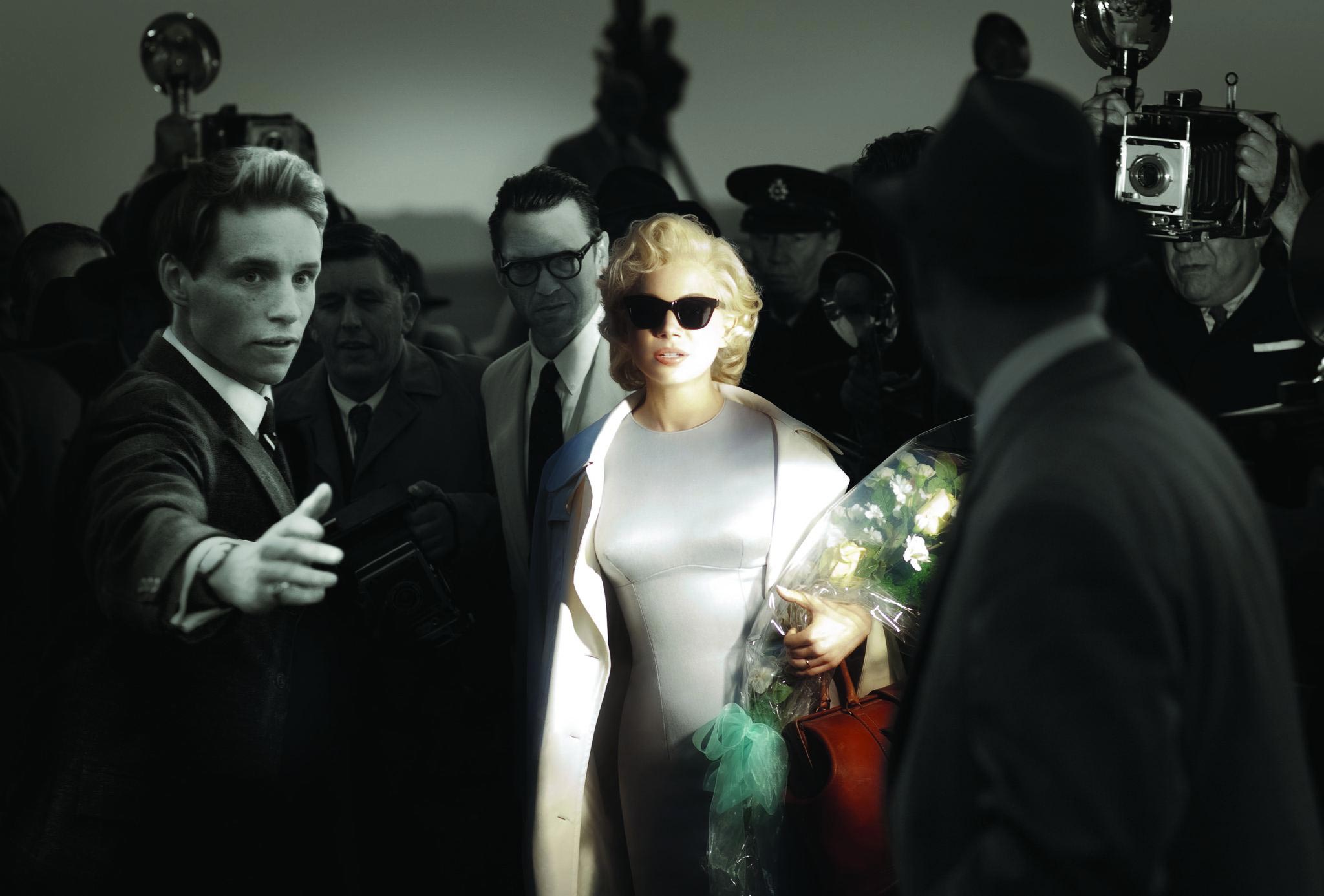
Examining "The Method" Of MY WEEK WITH MARILYN


"It's agony because he's a great actor who wants to be a film star, and you're a film star who wants to be a great actress.  This film won't help either of you."

Michelle Williams got plenty of attention for her work portraying Marilyn Monroe, and rightly so.  She is absolutely marvelous, both as the public persona of Marilyn and the sweet and simple Norma Jean hidden within.  In one of my favorite moments, she encounters a group of applauding fans while touring Windsor Castle, turns to her young admirer and asks, "Shall I be her?"  She instantly transforms before our eyes into the playful, flirting starlet that every man in America fell in love with.  Naomi Watts has also had a Marilyn biopic in development for a while but if that movie ever coalesces, as much as I love Watts, it'll be hard to watch her without secretly pining for Williams.  This might be the definitive portrayal for a generation.

The film actually feels pretty slight overall, a simple plot that's punctuated by some sharp performances by Williams, Eddie Redmayne and Kenneth Branagh as screen icon Lawrence Olivier.  Put simply, Marilyn traveled to England in 1956 to film a "light comedy" with Olivier, and while there she had a brief romance with a young crew member named Colin Clark (Redmayne).  It's not really a physical romance so much as an emotional one.  While they do kiss and go skinny dipping, Colin mostly served as an emotional confidante, someone who would speak honestly to her and to whom she could confess her personal fears and professional doubts.  When all is said and done, the movie itself feels much like Marilyn and Colin's relationship as well as the film we see her shooting: an enjoyable lark that's pleasant enough in the moment but doesn't really leave a lasting impression.  (The movie, The Prince And The Showgirl, was considered a minor hit that was eventually overshadowed by her next film, Some Like It Hot.)

The most interesting element to me is the conflict that drives so much of the tension on Oliver's set.  1956 sits at a kind of crossroads in the entertainment industry, a clash between two different schools of acting which are perfectly embodied by the two leads.  Olivier was a classically trained stage actor, and his performance style was very large and theatrical.  He relied on a mastery of accents and dialects as well as a precise control of both his body and has facial expression.  To Olivier, acting was simply a matter of adopting the correct physical and vocal mannerisms as the script demanded; it was essentially a learned set of skills.  On the other side of the coin was "The Method," to which Marilyn was an  enthusiastic devotee.  First made popular by Marlon Brando and legendary filmmaker Elia Kazan, The Method favored the actor's internal process over the external.  Utilizing tools like sense memory, the actor would try to find the emotional truth of the character in the given moment.  While the process was far more involved and complicated, the results spoke for themselves.  (Just watch Brando in On The Waterfront and compare it to most any movie from about ten years prior.  It's like night and day.)  Despite its name, The Method didn't rely on any one technique, and most of today's A-list actors utilize method acting in some form.

Needless to say the two schools didn't exactly play well together and if nothing else, My Week With Marilyn does a great job at exploring precisely why.  Olivier and his contemporaries arrive to set on time, don their wardrobe and makeup, and are in their place precisely on schedule.  Marilyn is the opposite.  She's frequently late to set, or holed up in her dressing room because she's not yet emotionally ready to perform.  She is constantly accompanied by her acting coach Paula Strasberg, whose husband Lee Strasberg created The Method in the first place.  While Marilyn depends on Paula to help her find the character's inner life, Olivier is beyond frustrated with her presence, as they can't even get through a simple table read without Paula stopping everything to pull Marilyn aside and get her to examine the character further.

That frustration certainly reminded me of much of my own early performing experiences.  Acting and directing was my major in college and the program I attended focused a lot on various incarnations of Meisner and Stanislavski's method.  Personally, I was never a strict follower of any one technique, approaching different roles and shows from different perspectives.  Sometimes I found it easy to identify with the character and could easily put myself in his shoes, whereas other times it was more about simply drawing on my own life to get in touch with the appropriate emotional state that the moment required.  But, like Olivier, I too would sometime grow frustrated with my classmates/castmates, some of whom would burst into tears at the drop of a hat and almost seemed to prize emotional instability as an asset.  Acting class became quasi-group therapy sessions and it all seemed rather besides the point to me.  Often times these emotional explorations resulted in a compelling performance, but it usually made for an exasperating work environment.

At one point Olivier laments that Marilyn should spend time doing stage work, as a theater company would never put up with such nonsense.  In a way, that speaks to the essential distinction between Olivier and Marilyn, between their differing performance styles, and between the theater and the film industries themselves.  Marilyn, Brando, Strasberg and their ilk understood something that Olivier did not: the camera will pick up all sorts of subtleties that do not come across on stage.  The arrival of the close up shot meant it was no longer simply about hitting your mark and articulating your lines clearly.  The actor needs to become a fully realized human character that reacts to the world honestly in the moment, because any falsity on camera becomes instantly obvious and pulls the audience out of the film entirely.  You can see it clearly whenever Marilyn and Olivier are in a scene together; she has a natural charm and charisma that is absolutely captivating and can't be replicated no matter what artificial pose, inflection or expression Olivier adopts.  There's a reason she was America's sweetheart.  When she's on camera, everything else simply fades into the background.  It's therefore easy to sympathize with Olivier when he tells Colin that he wanted to work with her in order to feel young again, but instead he feels even older.  Olivier can see the writing on the wall, that his revels now are ended and world he's dedicated his life to is about to leave him behind.

In the end, My Week With Marilyn is frustrating on a few levels.  Generally I applaud these sorts of biopic stories that choose a specific moment or era to examine a person instead of trying to cover an entire lifetime in two hours.  And Williams's performance is so great that I would gladly see a whole series of movies about her incarnation of Marilyn, but here it feels like her considerable talents are wasted on a story that never really goes anywhere.  A big part of the problem is that she's not the protagonist.  This tale belongs to Colin Clark, and therefore we only really see Marilyn through his eyes.  It's more about how Marilyn affected Colin than vice versa and ultimately I don't care about him nearly as much as I do about her.  It's not Redmayne's fault, as he does his best with the limited material, and while I found the conflict between Olivier and The Method to be far more fascinating, I'm not sure if it would really appeal to those without a performing background.

I wouldn't recommend you go out of your way for this one, but if the opportunity presents itself than it's worth watching just for Williams.  If nothing else, she made me excited to go find some old Marilyn movies and add them to my viewing list.

---------------------------------------
Title: My Week With Marilyn
Director: Simon Curtis
Starring: Michelle Williams, Eddie Redmayne, Kenneth Branagh, Emma Watson
Year Of Release: 2011
Viewing Method: Showtime (DVR)


March 04, 2013

TAKE THIS WALTZ Is An Opus Of Infidelity


Lou: Hey Margot!  I just bought a new melon baller and I'd like to gouge out your eyes with it.  
Margot: Yeah, me too.
A few years ago I saw actor/director Sarah Polley's heartbreaking film Away From Her and it pretty much wrecked me.  It's the story of a older married couple whose relationship slowly deteriorates as the wife, masterfully portrayed by Julie Christie, slips further and further into the mental abyss that is Alzheimer's disease.  It's especially tragic because the couple is truly and completely in love, but the husband is rendered powerless in the face of his wife's mental erosion.  He watches her slip away and there's nothing he can do to stop it.

Polley's follow up, Take This Waltz, also deals with a crumbling marriage, albeit a much younger one.  However, here Polley grapples directly with the issue of choice, as well as slippery slope of emotional infidelity.  What struck me most is Polley's ability to frankly and honestly capture the terrifying, exciting, fragile, passionate, and ultimately destructive nature of a relationship where one person continues to deceive not only their partner, but also themself.

Michelle Williams plays Margot, a young Canadian travel brochure writer who is five years married to Seth Rogen's Lou, a nice guy focused on writing a cookbook entirely of chicken recipes.  While on assignment, Margot has a chance encounter with rickshaw driver Patrick (Luke Kirby), a guy with a peculiar mix of both laid back charm and smoldering intensity.  After some idle flirting on the plane ride home, Margot confesses that she's married, at which point Patrick confesses that he actually lives across the street from her.

The two begin to spend time together and their attraction is undeniable, but Margot is seriously conflicted.  After five years of marriage, she and Lou have settled into a groove as best friends who live together and care for each other.  When the two are lying in bed in the morning, or entertaining Lou's family for Sunday dinner, they have a strong emotional connection and appear by all rights to be completely adorable.  They care for one another and love to make each other laugh using silly voices or private jokes like a running gag where they describe all the ways they want to physically torture each other to express their love, e.g. the melon baller quote at the top.  And yet, something is missing.  Their sex life has gone adrift and whenever a sweet moment turns to physical romance, a single stray word or reaction freezes the moment cold.

Lou and Margot's caring but stagnant relationship absolutely resonated with me.  Over the years I tended to jump from one long term relationship to another and I've definitely been in that position before, maintaining a relationship that on one level simply isn't working because on another level everything is hunky dory.  It's just exhausting to bounce back and forth between the two states, perfectly content one moment and wholly frustrated (sexually or otherwise) the next.  There's a part of you that is terrified to leave something comfortable and familiar, so you convince yourself that if you just stick with it long enough, eventually you'll find your way back to happiness.  Then there's the part of you that's so desperate for connection that you'll accept temporary pain and heartbreak (yours and/or theirs) and even the possibility of serious regret for a chance at finding happiness in someone new.

And so Margot is drawn to Patrick, and while they never physically consumate their desires, there's no question that she's cheating on Lou.  She wakes up hours early just to be alone with him.  They go to an amusement park and ride on the twister together while listening to "Video Killed The Radio Star," rocking back and forth in the cart and always on the verge of kissing.  They even go for afternoon martinis one day, with Margot suddenly blurting out, "I want to know what you'd do to me," and Patrick quietly describing exactly what he'd do in prurient detail.

The whole thing culminates in a hypnotic sequence where Margot steps outside her house one night and says, loud enough for Patrick to hear from his porch, "I'm going for a swim."  She walks to the public pool, Patrick silently following a few steps behind her.  They don't acknowledge each other until they both jump into the water, swimming circles around each other, one floating above and the other diving below until Patrick eventually reaches out and touches her ankle.  The spell is instantly broken and Margot quickly apologizes and retreats home.

As much as she wants Patrick, Margot says she can't bring herself to hurt Lou.  She doesn't seem to consider the idea that she essentially already has, even if Lou doesn't know it yet.  I don't think this attitude is out of naivete, but rather a defense mechanism of emotional dishonesty.  During their initial airplane encounter, Margot tells Patrick that she a sort of phobia about connecting flights.  It's not that she's afraid of missing her flight, it's that she's afraid of being afraid.  She therefore pretends to have a leg injury so flight attendants will ferry her from terminal to terminal in a wheelchair.  This is essentially a reflection of her dual relationships.  She knows that her marriage is broken but she's afraid of both being alone and of missing a potential connection with Patrick, and that fear has driven her to bend the rules to the absolute point of breaking.

Eventually it's Patrick who realizes that the situation is untenable and one morning he packs up his car and moves out.  His departure finally forces Margot to admit the truth, both to herself and to Lou.  It's a really well executed sequence where we never see the actual conversation, but instead just get a series of quick-cutting close ups as Rogen runs through a dozen different emotions in reaction to her bombshell.  In a moment that's equally funny and heart wrenching, he finally suggests that Margot take a shower.  You see, there's been a running gag where whenever Margot is in the shower she gets a momentary blast of cold water.  While she thinks the plumbing is broken, Polley shows us that in reality Rogen keeps a cup of cold water nearby and splashes her sight unseen from over the shower curtain.  After he's convinced her to get into the shower once more, he again dumps the cold water on her but immediately pulls back the curtain.  When she realizes the truth, he says, "I thought, when we're 80 I'll tell Margot I've been doing this her entire life and it'll make her laugh.  It's kind of a long term joke."

Having admitted marital defeat, Margot runs off and finds Patrick and we're treated to an extended montage of the two making love in his new home as time passes.  The sex gets adventurous, including some pink fishnets and the presence of a few different third parties, until they too find themselves sitting wordlessly on the couch, watching dull TV interviews.  When Margot tells Patrick that she "wuves him" in the same silly baby voice she once used with Lou, he tiredly says he loves her back.  She's once again found herself stranded in yet another relationship that's left her feeling somehow unfulfilled.

The crux of the film is actually articulated by Sarah Silverman, playing Lou's alcoholic sister Geraldine.  Margot is called back to Lou's when Geraldine falls off the wagon and goes missing.  She soon returns and pulls Margot aside to call her out on her shit.  Geraldine isn't just sticking up for her brother, but really articulating some harsh truths that Margot's been loathe to admit to herself.  Equating her own alcoholic mistakes with Margot's fear of missed connections, she says, "Life has a gap in it, it just does. You don't go crazy trying to fill it like some lunatic."

I don't think the ultimate message here is to settle for the middling, but rather to recognize that no matter what you do, there's always going to be some part of your life that isn't quite where you want it to be.  It's that pursuit of happiness, the struggle to square our own individual circles that continues to drive us forward in this world and allows us to grow as individuals.  The key is to appreciate the love and happiness we've already been lucky enough to discover in our lives.  Otherwise we risk losing one joy in pursuit of another.

That's probably good advice for me, as I embark on this cinematic mission that was at least partially conceived to fill in the gaps in my own life, like some lunatic.


---------------------------------------
Title: Take This Waltz
Director: Sarah Polley
Starring: Michelle Williams, Seth Rogen, Luke Kirby, Sarah Silverman
Year Of Release: 2011
Viewing Method: Netflix Instant (TV)