Showing posts with label johnny depp. Show all posts

April 23, 2015

Johnny Depp Wears No Stupid Hats In This BLACK MASS Trailer


Twice this week I've found myself involved in conversations about Black Mass, the Whitey Bulger biopic starring Johnny Depp as the infamous Boston mobster and FBI informant.  It's remarkable considering that, before a few days ago, I kind of forgot that the movie even existed.  You can hardly blame me - Johnny Depp hasn't given us serious reason to get excited about one of his movies in quite some time.  I've been curious, as I am with just about any movie set and shot in my home town, but it's fair to say that my expectations have been pretty low up until now.

Today we got our first look at the film courtesy of this trailer and I must admit, I'm more than a little impressed.


First things first: unless you count his hairpiece, Johnny Depp makes it through all two minutes of this trailer with nary a silly hat in sight.  Huzzah!  And those blue contact lenses give him a serious case of Crazy Eyes.  It's also worth noting that Depp manages to pull off one of the more convincing Boston accents in recent memory.  It's one of those very particular vocal traits that's easy to exaggerate in a comedic context but harder to portray naturally, let alone utilize with genuine menace.  The Departed (whose Frank Costello was based largely on Bulger) is one of the high watermarks in this regard.  Mystic River is like nails on a chalkboard to my ears.

I hadn't realized that the cast was so stacked either!  Joel Edgerton is always a welcome addition to any movie, and I'm a big fan of Dakota Johnson, 50 Shades notwithstanding.  Plus Lance/Landry!  And might we be treated to the dulcet tones of Benedict Cumberbatch's version of a Southie drawl?  I live to dream.


July 31, 2014

Three More Minutes Of BIRDMAN! "There You Go, You Motherfucker!"


While everyone else is fawning over 3 seconds of Johnny Depp's wolf-fingers in that new Into The Woods teaser, I'll be watching this new Birdman trailer on a constant loop.

Now if you'll excuse me...


November 01, 2013

24 Hours Of Halloween Horror Part II: Revenge Of The Coolidge!


I’m a bit of a crazy person.

My friends Jason and Lucy loooooove Halloween and, more specifically, Halloween movies.  Every year they host a movie marathon full of all sorts of crazy shit and I’ve been looking forward to it ever since they first put the bug in my ear a few months ago.  They set the date for the Saturday before Halloween, scheduling 12 hours of non-stop horror from noon to midnight.  The only hitch was that I had already planned on attending the Coolidge's 13th Annual Halloween Marathon, taking place immediately thereafter from midnight to noon.  For most people this would present an insurmountable problem, forcing them to choose one marathon over the other.

I just said fuck it and went to both.

---------------------------------------

Like a lot of independent movie theaters, the Coolidge really goes all out for Halloween.  This year they kicked off their annual Halloween movie marathon with a quick but energetic set from local punk band The Mangled Dead, whose skeleton faced lead singer skateboarded down the aisle and onto the stage.  The performance was quickly followed up with a costume contest.  I was wearing my newly acquired Stay-Puft Marshmallow Man costume, but I was hopelessly outmatched by the other competitors, which included a giant flag waving Sgt. Slaughter, Tippi Hedron from The Birds, the personification of Roscoe's Chicken and Waffles (yum) and the best Gozer the Gozerian I've ever seen.  But the eventual victors were two guys who sat on the shoulders of two other guys and then wore long coats, bowler hats and fake mustaches, explaining that they were "two perfectly ordinary gentlemen who are certainly old enough to see this movie."  The clever gag quickly became an endurance test to see how long the guys on the bottom could hold out before collapsing or dropping their friends, but that only endeared them to the crowd even more.  After that it was movie time.

The only titles that the Coolidge announced in advance were the first two movies, Alfred Hitchcock's Psycho and Tobe Hooper's The Texas Chainsaw Massacre, both of which were influenced by real life killer Ed Gein.  I've each both film a few times and totally love them, but I made an executive decision that if I was going to make it through some of the later films that I surely would not have seen, I was gonna need some nap time.  So I stayed awake through all the Marion Crane stuff in Psycho and the great scene where Arbogast interrogates Norman Bates and then gets pushed down a flight of stairs for his trouble, but otherwise I closed my eyes and let myself drift off throughout the movie.  And I caught the beginning of Texas Chainsaw including the great scene with the hitchhiker in the van, but then I dozed off until Sally hailed down the truck driver at the very end.    Next up was A Nightmare On Elm Street, which I had just watched the previous night, so I actually took that time to be productive.  I slipped out into the hallway, pulled out my laptop and knocked out my Krueger write up, popping back in just to see Johnny Depp get liquefied.

13 Ghosts (1960)

Oh that William Castle.  What an innovator.  Castle is considered the king of B-movie horror, but here's a guy who absolutely reveled in fucking with his audience while generating active engagement and interaction with the images on screen.  And he always came up with the most adorable names for his theatrical gimmicks.  The House On Haunted Hill included "Emergo," consisting of an actual skeleton on a wire that would fly out over the audience to mimic the onscreen action of the film's finale.  The Tingler was about a creature that would attach itself to the human spine and could only be killed by the sound of screaming.  In the end the creature is said to have gotten loose in the theater, so Castle bought up surplus airplane de-icers from the military and attached the vibrating motors to the bottom of some theater seats, calling it "Percepto."  (The urban legend is that Castle actually gave audience members electric shocks.)  But 13 Ghosts utilized what Castle called "Illusion-o": the audience members were given "ghost viewers," similar to the traditional red and blue 3D glasses but with the lenses laid out as parallel horizontal panes.  The film is shown in black and white, but any scene that includes a ghost is colored blue while the ghost itself is shown in red.  If you wanted to see the ghost you'd look through the red pane, but if you were "too scared" you could look through the blue pane and it would remain invisible.

While the Coolidge didn't have the original ghost viewers handy (and they would have been too expensive to actually make again) they did have a supply of 3D glasses that they handed out.  Whenever a ghost scene came up, you'd drop the glasses down over your eyes and then just close one eye or the other depending on what view you wanted to see.  If you kept both eyes open you could see both images at the same time and there was a faint 3D-ish effect while your brain tried to resolve the two colors.  It was really entertaining and  I can't help but think that Hollywood is in dire need of a new William Castle, a filmmaker who's willing to really go out on a limb in order to build unique theatrical experiences that will make people really want to go to the theater again.  Then again, Emergo screenings eventually devolved into a bunch of kids throwing empty soda cups and candy boxes to try and knock down the skeleton, which is pretty much the 1950's version of kids texting during the movie.

I don't have much to say about the movie itself, about a down on their luck family who inherit a haunted mansion, because I'll admit that I inadvertently drifted off a few times through this one as well, but I always managed to wake up whenever there was ghost effect happening.  Even still, I'm now morbidly curious to check out the remake with Matthew Lillard.


More Fulci!  This one is not nearly as coherent as Zombie Flesh Eaters, but it certainly is sillier. Again we've got a family that moves into a creepy old house (by a cemetery!) but instead of ghosts this one has an immortal mutant of sorts living in the basement.  After a researcher goes mad and seemingly kills himself and his mistress while investigating the experiments of a crazy scientist named Dr. Freudstein, Norman Boyle moves his wife Lucy and young son Bob into the man's house to continue the research.  Bob soon meets a little girl that no one else can see, there's a weird babysitter who doesn't talk and a whole lot of characters behaving in ways that make little to no sense.  At one point the family grows so disturbed that they tell the estate agent they want to move out of the house immediately.  The agent soon arrives at the empty house and is brutally murdered by the evil basement dweller, leaving a huge trail of blood across the floor.  The next scene shows mute babysitter Ann scrubbing away the blood only to have Lucy walk in with a bag of groceries, acting like there's absolutely nothing strange about that.  There are no more discussions of leaving the house.  The traditional Italian post-dubbing of all the dialogue certainly doesn't mitigate the inadvertent humor of it all and only makes the whole enterprise feel even more absurd.  And every time young Bob opened his mouth, especially whenever he was talking to his possibly imaginary friend, all I could think of was the kid from Pod People, my favorite episode of Mystery Science Theater 3000.

There is some great gore and a couple of really awesome death scenes, including a sweet decapitation and a whopper of a kill in the first few minutes.  But there are long stretches of the film that are unbearably slow.  It's an oddity to be sure, a few moments of delightful insanity surrounded by a borderline incomprehensible mess.

Near Dark (1987)

At this point it was about 8:00 AM and the crowd had definitely thinned out a bit.  The staff had stopped introducing every film after 13 Ghosts, which meant we got no preface, description or explanation for what we were about to watch and had to discover it all as it unfolded.  I'd never heard of Near Dark before, but as every credit flashed across the screen I knew I was in for a treat.  Lance Henriksen.  Bill Paxton.  Adrian Pasdar.  Written and directed by a pre-Point Break Kathryn Bigelow.  I'm already in.

Pasdar jumps out of his pickup truck in a dusty denim jacket and a beat up cowboy hat, and it suddenly hits me like a ton of bricks.  There's always been something oddly familiar about him but I could never place my finger on it.  But seeing him as a Caleb The Cowboy I had a flash of Necessary Roughness and finally realized that Pasdar is an off-brand, humorless version of Scott Bakula.  Henceforth he shall be referred to solely as Not Bakula.  So Caleb The Cowboy meets a hot, ethereal young blonde named Mae and they drive around and look at the stars for a while until Mae really wants to go home and Caleb The Cowboy refuses to give her a ride until she makes out with him a bunch.  She obliges and then takes a big old bite out of his neck and HOLY SHIT Kathryn Bigelow made a vampire movie and nobody told me!

The sun comes up as Caleb The Cowboy is stumbling home and he's starting to look a bit extra crispy when suddenly a Winnebago with blacked out windows pulls up and grabs him right in front of Caleb's father and sister.  Inside we find Lance Henriksen as lead vamp Jesse, Jenette Goldstein as his wife Diamondback, an adolescent vampire named Homer (not making this up) and a full-on manic Bill Paxton as Severen, the loose cannon vampire.  This thing just gets better and better!

Then it doesn't.

Look, if this was a movie about an awesome cadre vampires (played almost entirely by the space marines from Aliens) who steal cars and attack dumb hillbillies as they wander across the southwest, well you couldn't pry me away from that movie.  Especially with Henriksen and Paxton at the wheel.  There aren't a lot of pointy fangs or transformations or really any of the traditional vampire tropes.  In fact, nobody ever says the word vampire, which lends the whole thing a somewhat classier vibe.  But whenever the Weyland-Yutani crew are on screen, everything pops.  There's a scene where the posse wanders into a dive bar and each vampire gets to take down the patron of their choice.  But instead of a fast and brutal attack, it's all done with cheeky and lackadaisical sense of fun - these guys really like to play with their food.  That's not to say it isn't violent; the waitress gets her throat ripped open, but instead of sucking her dry Henriksen shoves a beer mug under the wound and and fills it up, using her throat as a beer tap.  And I simply cannot overstate how wonderfully psychotic Paxton is here.  Look, I like Apollo 13 as much as the next guy, but I really miss young, vibrant Bill Paxton.  There's also a daytime shoot out with the cops at a motel that's brilliantly staged; the cops don't know they're dealing with vampires, but they're outside shooting holes in the walls and each hole lets in a shaft of sunlight that acts like a laser beam to the solar-averse banditos inside.  It's both energetic and beautiful, all the more impressive considering that it was Bigelow's first solo directing gig.  It's little wonder she's got an Oscar.

Unfortunately, Not Bakula kind of sucks.  He's squeamish about killing people so he spends most of the film moping around being lame while Paxton gives him shit for being such a wimp.  He doesn't belong in this crew of badasses and everyone knows it.  But there's also no dire conflict between Caleb The Cowboy and his new undead family.  He doesn't seem to mind the fact that they're totally fucking evil so long as he gets to keep making out with Mae and doesn't have to get his own hands bloody.  It's only when they accidentally bump into Caleb's family and Homer wants to turn his sister into a new immortal playmate that Caleb The Cowboy decides to abandon the group and return home.  It's hard to watch Near Dark without thinking of the The Lost Boys, especially since they were released in the same year.  Unfortunately for Bigelow and Not Bakula, the former utterly pales in comparison to the latter, lacking the sense of fun that comes part and parcel with the presence of The Coreys.  Also, the romance between Caleb The Cowboy and Mae is the dullest, least sexy vampire romance I've ever seen.  Oh yeah, and they cure Caleb's vampirism with a simple blood transfusion.  Lame sauce.

Near Dark is nearly a good movie.  The story is pretty slight, but I honestly wouldn't mind that if only the incredible supporting cast wasn't being dragged down by the lead weight of Not Bakula.

Brain Damage (1988)

Part low budget schlock horror, part after school special, Brain Damage is the tale one man whose life gets flushed into the shitter due to his own unfortunate addiction.  The rub is that his addiction comes in the form of Elmer (or Aylmer), a blue, wormlike parasite with adorable eyes and the voice of a friendly neighbor who releases a chemical that allows the host to totally trip balls while experiencing psychedelic euphoria.  But while you're busy tasting colors, Elmer off in the corner eating some poor fool's brain.

The story is your basic morality tale detailing the nightmares of drug addiction.  Our protagonist Brian gets seduced by the smooth talking and just this side of cute Elmer, who promises incredible highs if Brian will just put the creature on the back of his neck.  Elmer unhinges his jaw, revealing the horrifying array of jagged teeth, and extends a long needle from inside his mouth that reaches all the way into Brian's brain and drips a blue liquid onto his grey matter.  It makes Brian downright giddy and the experience is so intense that soon his normal life just doesn't measure up.  He locks himself away in his room, stops going to work and won't talk to his brother or his girlfriend Barbara.  And when he does go out on a date, he ends up running out on her and getting high in the alley, only to wander into a punk club and get a blowjob from a random woman in leather who ends up getting a mouthful of Elmer.  Not a euphemism, although I think I just made it one.

Once Brian realizes that people are dying and the old man that Elmer escaped from delivers a long monologue explaining the creature's intricate history, Brian locks himself away in a seedy motel room and tries to quit cold turkey.  He ends up going through a painful withdrawal, twitching and foaming at the mouth while Elmer splashes around in the sink and taunts Brian, even singing a fucking song about his own awesomeness.  Eventually Brian gives in and the two basically go on a killing spree that includes his now ex-girlfriend who's found comfort in the arms of Brian's brother.  Needless to say, it doesn't end well for Brian.  Like any good drug addict, eventually he overdoses and gets so much juice to the brain that his head literally explodes in light.

All the drug stuff is about as subtle as a mouthful of Elmer and you're certainly not going to dazzled by the dramatic prowess of star Rick Hearst, but that little blue worm is such an oddly entertaining creation that you simply cannot take your eyes off of him.  His voice is almost hypnotically soothing, like the host of an easy listening radio station, and the combination of puppetry and stop-motion feels like the unholy demon spawn of Jim Henson and Henry Selick.  It's unreal, in that I can't believe this is a real movie.  Fans of director Frank Henenlotter, a.k.a. the man behind Frankenhooker, will recognize a familiar man and his basket riding on a subway car near the end.

This is how I'm going to teach my children about the dangers of drug addiction, and I don't even need to buy it because you can watch the whole thing on YouTube.

---------------------------------------

The lights came up and the once packed theater was now only about a quarter full.  I gathered up my belongings, stumbled out into the sunshine and drove home just in time for the start of the Patriots game.  You'd think that I would have passed out for the rest of the day, but I was surprisingly alert.  It's at this point my wife would point out that I almost never consume caffeine, not out of any kind of pretension or moral superiority, but simply because I don't like the taste of coffee and soda.  Unless there's booze involved, of course.

The Pats put the beatdown on Miami and a few hours later the Sox got retribution for Game 3: up by two runs in the bottom of the ninth with two outs, a man on first and Carlos Beltran, one of St. Louis's best hitters at the plate, Red Sox closer Koji Uehara snapped the ball to first baseman Mike Napoli who tagged out the runner.  It was the first time a World Series game has ended on a pickoff play.

We were still in this thing.


October 27, 2013

I Expected A Lot More From A NIGHTMARE ON ELM STREET

 “What is seen is not always what is real.”
For much of my life, Freddy Krueger has been considered the paragon of terror, the king of all psycho movie killers.  But while Friday The 13th genuinely surprised me with its smart and brutal filmmaking, A Nightmare On Elm Street feels like a trashy dime store comic book by comparison.

That makes sense to a certain degree.   Although he’s not actually present (in his most recognizable form) in the first Friday The 13th, Jason Voorhees is a flesh and blood attacker who’s extremely difficult to kill.  On the other hand, Freddy Krueger is ephemeral, a supernatural villain who exists purely in the dreams of his victims but whose lethality is not diminished by his lack of corporeal form.  As a result, he delights in torturing the local teens in a variety of almost cartoonish forms.  And while I’m always a fan of practical effects work, stuff like long-armed Freddy, Freddy wearing a Tina mask, and Freddy's tongue coming out of the phone receiver are actually more amusing than scary.  The sequences that work the best are the ones that focus more on the really intense gore, stuff like Amanda Wyss’s evisceration on the ceiling, or Johnny Depp’s bed sinkhole turned inverted geyser of blood.

I’m more surprised by all the movie’s missed opportunities.  The scariest thing in the entire film is the massive sleep deprivation.  These kids are terrified of what will happen when they fall asleep, so they end up going a full week without rest.  That will fuck a person right up, but there’s not a lot of attention paid to the possible side effects of keeping your eyes open for seven straight days.  Sure, we see Nancy popping some pills and chugging a lot of coffee (I particularly loved when she pulled a Mr. Coffee out from under her bed) but it just feels like lip service to a plot point.  Presumably Depp is also awake for most of the film but he remains completely level-headed throughout; he never gets manic, just drowsy.  This makes Nancy’s behavior feel less like the result of sleep deprivation and more like clichéd female hysteria.  They touch briefly on the idea of “dream skills,” or taking control of the dream in order to take away Freddy's power, but it’s never explored in any really meaningful way and quickly gets dropped in favor of pulling Freddy out of the dream and trapping him in a series of  elaborate Home Alone-style booby traps, which Nancy is hilariously able to set up in the span of ten minutes.

But the whole point of Freddy is that he’s an spirit wreaking vengeance upon the neighborhood kids as punishment for the sins of their parents.  Nancy’s mother explains that the real Fred Krueger was a child murderer who managed to evade conviction on a technicality, prompting the local parents to form a lynch mob, trap him in a boiler room and roast him like a charcoal briquette.  But Nancy’s parents are the only ones who readily admit their role in all of this carnage, and they don’t really express any remorse for their actions either, at least not until kids start dying.  Nancy’s mother drinks herself into a stupor and we barely glimpse any of the other parents at all, let alone discover whether they were involved in Freddy’s death.  Sure it makes for a nifty origin story for the character, but it also feels like an interesting thematic element that gets largely paved over in favor of more finger knives.  That's understandable, but it's disappointing all the same.  I remember hearing that the recent remake, with Jackie Earl Haley as Krueger, actually started with that lynch mob scene, so I’m curious to see if that movie picked up the thread further or did anything at all interesting with it.  I’m not getting my hopes up.

The end is also totally ridiculous.  After burning to death in the real world for the second time, Freddy reappears once more in Nancy's dream.  This leads her back to the "dream skills" strategy and she seemingly wills Freddy out of existence.  (Hilariously, the exact same ending was used in Rise Of The Guardians.)  That just feels like Wes Craven wrote two different endings and couldn't decide which one to use, so he stuck them both in.  Then the whole movie is basically retconned away and everyone comes back to life with no memory of what transpired.  That is until Freddy suddenly shows up to suck Nancy's mother through a window and possess Johnny Depp's car.  What the fuck is that all about?  Are they really alive?  She has to be imagining it right?  Since Freddy can't actually appear in the real world unless someone pulls him out of a dream?  So did Freddy not get sent back to hell a minute before?  Something doesn't fit here.


I’ll tell you one thing: a green and red striped convertible top doesn’t hold a candle to demon-child Jason popping up out of the lake.

You win, Friday The 13th.

---------------------------------------
Title: A Nightmare On Elm Street
Director: Wes Craven
Starring: Heather Langenkamp, Robert Englund, Amanda Wyss, Johnny Depp, John Saxon, Jsu Garcia
Year Of Release: 1984
Viewing Method: Netflix DVD


August 26, 2013

Wife's Choice: Overindulging In CHOCOLAT


"Very good...but not my favorite."
You guys, I am getting FAT.

I'm not just being vain here.  I've never been in terrific shape and I've long since made peace with the fact that I'm never going to have a six pack or bulging biceps or really muscle definition of any sort.  I'm okay with all that.  What I'm not okay with is the fact that I'm currently unable to wear half the clothes in my closet.  That is NOT cool.

It wasn't always like this.  In the lead up to my wedding last year, I started eating better and, for the first time in my life, started going to the gym two or three times a week.  The results weren't exactly dramatic, but I was definitely a bit slimmer and, more importantly, I was proud of myself for making progress in an area of my life that I'd been long neglecting.

But here's the thing: ever since I started this project, the time that I would have spent at the gym is now spent watching movies.  Also, my wife really likes to cook delicious things.  This is a bad combination.

I guess, like anything else, it's just a matter of dedication.  Jamie has decided to go pescatarian for a while, but I love red (and white and really all) meat too much to quit it cold turkey.  But I can still take steps to eat better.  Sadly this probably means less nachos.  I  should also carve out time to exercise and actually make use of the gym membership I'm paying for each month.  Yes, that's going to carve into my sitting-around-drinking time, but that's probably not a bad thing.  It doesn't seem totally unreasonable to come home and hit the gym before I settle in for a movie a few times a week.  It'll push my nightly schedule back a bit and it'll certainly mean watching less TV once the fall schedule kicks in, but at this point it's a choice between Andy Samburg's cop show and fitting into my pants.  I think I've gotta go with pants.

Anyway, this is all by way of saying that I recently watched Chocolat, starring Juliette Binoche, Alfred Molina and Johnny Depp.  At the urging of Paul Rudd, Jamie and I split a bottle of wine and a summer salad.  (The grilled salmon was my idea.)


It was delightful.

Just like Jason Segel said it would be.

---------------------------------------
Title: Chocolat
Director: Lasse Hallstrom
Starring: Juliette Binoche, Alfred Molina, Johnny Depp, Judi Dench, Lena Olin, Carrie-Anne Moss, Peter Stormare
Year Of Release: 2000
Viewing Method:  DVD


July 03, 2013

THE LONE RANGER Is Aggressively Awful, Makes Me Despair For Intelligent Audiences


"They were gonna violate me with a duck's foot!"
Jesus Fuck, there simply isn't enough firewater in the world to get me to watch this movie again.

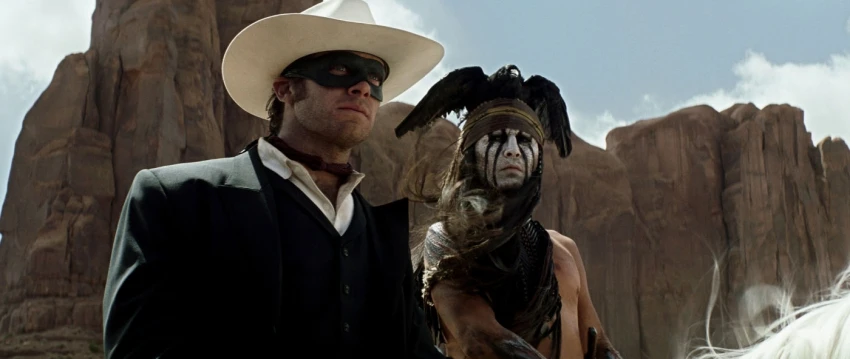
My problems with Disney's The Lone Ranger are perfectly encapsulated in the film's very last scene.  The Lone Ranger, wearing his signature black mask and white hat, sits atop his trusty steed, Silver.  He rears the horse back on its hind legs, holds his hat up in the air and cries out, "Hi ho, Silver!  Away!"  It's the character's classic pose, a perfect iconic image.  The film then immediately cuts to Johnny Depp's Tonto, who looks at the Lone Ranger with a look of absolute horror and yells, "Don't ever do that again!"

If that's how you feel about the character, why the fuck bother making this movie?  And what's worse, the audience I was with reacted like it was THE FUNNIEST GODDAMN THING THEY'VE EVER SEEN.

Let's rewind.  First of all, an irate aside: Since I was attending a preview screening, I had to go through Disney's draconian security process to get in.  Now I worked security for these kinds of screenings for the better part of four years, so I know exactly how this game is played.  You want to take my phone away because it has a camera?  Fine.  It's annoying, but understandable, even if the movie I'm about to watch hits theaters in a mere three days.  I will surrender my iPhone and accept it as the cost of doing business.  But you know what you don't need to confiscate?  Some lady's headphones.  Or the Kindle of the guy in front of me.  Or my fucking flash drives.  I'm all about preventing piracy, but there's no reason that we can't have policies which operate on the most basic awareness of how technology works.  Just because something contains a circuit, that doesn't make it a recording device.  (It's the same reason I hate being told I can't read my Kindle on a plane during takeoff, despite the fact that the whole point of e-ink displays is that they literally do not use any power except for the moment you flip the page.)  If you really think that I'm hiding a camera in my headphones, then the security guards who you're paying to stand in the theater with night vision scopes will certainly catch me.  But there's no reason to make getting in the theater (or retrieving my belongings after the show) any more arduous a procedure than absolutely necessary.

Okay, rant over.  What about the actual movie?

This is a film that is chock full of terrible decisions, most if which can be attributed to screenwriters Ted Elliott, Terry Rossio and Justin Haythe. There's the basic, conceptual stuff like turning The Lone Ranger into a wimpy lawyer who spends most of the movie refusing to use a gun and the rest of the movie pulling off incredible trick shots entirely by accident. Or there's the utterly pointless inclusion of the wraparound scenes with Old Man Tonto relaying the entire story to a kid at a traveling fair in 1933, all of which plays like the Fred Savage scenes from Princess Bride but without the innate charm of Peter Faulk. And let's not forget the utter lack of consistent tone, with the film constantly switching between dark, savage violence (like the compete massacre of not one but TWO Native American tribes) and zany, cartoon stunts like the magical white horse who climbs onto roofs or into trees for no reason other than OH MY GOD, THAT HORSE IS CRAZY!

In fact, it's utterly astounding just how packed to the gills this movie is with incredibly broad humor that just doesn't land.  There are all these terrible bits with giant-fanged CGI rabbits that are supposed to indicate that nature is somehow out of balance, but don't worry if you find it confusing because it's not a plot point that goes anywhere or means anything. The movie also contains the single most tasteless, borderline offensive joke of the year, in which Tonto threatens to rape a transvestite bandit with a petrified duck's foot.  Seriously. Not only is this stuff not funny, but they're clearly playing to the absolute dumbest motherfucker in the room, as evidenced by a closeup shot of Silver taking a huge dump and then Armie Hammer getting dragged through the ensuing pile of horseshit.

And the audience absolutely ate it up.  Couldn't get enough of it!  "More horse poop!"

I was joking on Twitter before the screening about the public's love of Johnny Depp wearing a funny hat, but now that comment feels downright prescient.  It's common knowledge at this point that Depp spends the movie with a dead crow perched atop his head, but just to drive the image home he is constantly trying to feed the thing peanuts and birdseed.  Once or twice would have been funny, but eventually it basically devolves into a weird character tic that my audience totally fell in love with while I searched for pointed sticks to jab into my eyes.  Where Captain Jack Sparrow was a competent, lovable rogue, Tonto is quickly revealed to be nothing more than a idiotic, delusional asshole.  The same can be said Johnny Depp.  There's no more debate over whether not the guy's shtick has jumped the shark, now its just a question of how high. Depp is constantly clowning and mugging for the camera while cracking jokes in an oddly modern parlance, but then in the middle of all his red-face bullshit there will be glimmer of hope, a quick flash of brilliance that reminds me  why he can be such a compelling onscreen force when he wants to be.  But then it's gone just as swiftly as it appeared and I'm forced to admit that, much like Tim Burton, Gore Verbinski is a director who now only enables Depp's  very worst tendencies.

I'll give Verbinski this: he shoots the living shit out of the thing, filling the frame with a million moving pieces hurtling at breakneck speeds, yet somehow bringing order to the chaos and managing to make it look downright beautiful at times.  But there's just no saving this runaway train.  It's about a half an hour longer than it needs to be, it strands great character actors like Tom Wilkinson, William Fichtner, Barry Pepper and Helena Bonham-Carter with absolutely nothing to do, and it sets the bar for humor and storytelling impossibly low...then somehow manages to trip over it.  The only person I feel really bad for is Armie Hammer, a seriously talented guy who's clearly giving it everything he's got but is ultimately stuck playing a character that just flat out doesn't work as written.

This is an objectively bad movie.  Just awful on every front.  But what really put it over the top for me was the moronic, mouth-breathing audience that surrounded me.  Their reactions just astounded me at every turn. Not only did they crack up laughing at terrible jokes, (or every single time Depp fed that fucking bird), but they even laughed at things that were clearly not jokes.  Late in the film (too late) the Lone Ranger finally realizes that his much vaunted society of law and order has become utterly corrupt and that he must take matters into his own hands.  He and Tonto sit in the darkness on a riverbank, dejected after watching the U.S. Army slaughter an entire tribe of natives solely to cover up a silver theft.  As the Lone Ranger sits by the water, a man betrayed by the system he prized above all else, Tonto slowly holds up the black mask, offering him a means to find justice and to save the the people he loves...and the audience started cackling.  I honestly couldn't tell you why.  Here's an even more befuddling example: early on, when the Lone Ranger's brother Dan, one of the movie's few well defined characters played to the hilt by James Badge Dale, prepares to ride off with his posse to capture William Fichtner, he has a long, drawn out goodbye with his wife and son, underscored by a super heavy-handed musical cue.  It's very clear that he's saying goodbye to them for the last time and won't be coming home alive.  And yet, when he gets shot down ten minutes later, the room reacted with complete shock and surprise.  The same when the Ranger's love interest is casually backhanded by a villain in the middle of a big action scene and appears for a quick moment to fall out of the train.  This is a major character who we've spent a lot of time with, the kind who don't get accidentally pushed to their death while seven other things are happening.  And yet, I heard people gasping as if they thought she'd really been casually killed.  Walking out of the theater, I felt like I was living in a present day Idiocracy.  These people not only lost their minds and the stupidest jokes imaginable, (they'd probably line up for a show called Ow, My Balls) but they had apparently never seen a movie before.  As bad as the film was, watching it with that audience only increased my anger and frustration exponentially.  It actually made me long for the version of this movie that was about werewolves.

I don't know what more I can possibly say to warn you off of seeing The Lone Ranger.  It's an absolute failure on every conceivable level and it encapsulates all of the absolute worst instincts of the modern Hollywood machine.  It instantly leaped to the top of my "Bottom Ten" list and I'll be astounded if anything can manage to knock it from it's shitty throne.

Be warned: your punishment for buying a ticket to The Lone Ranger is that you have to watch The Lone Ranger.


---------------------------------------
Title: The Lone Ranger
Director: Gore Verbinski
Starring: Johnny Depp, Armie Hammer, William Fichtner, Tom Wilkinson, Helena Bonham-Carter, James Badge Dale, Barry Pepper, Ruth Wilson, Stephen Root
Year Of Release: 2013
Viewing Method: Theatrical - AMC Boston Common (Advanced Screening)


April 04, 2013

THE THIN MAN Is Still Funny After All These Years


"Can you tell us anything about the case?"
"Yeah, it's really getting in the way of my drinking."

I've previously discussed the lopsided nature of my movie watching experience.  Generally speaking, if it was made in my lifetime then I at least have a passing familiarity with it.  But that leaves decades of classic films which I've never seen and know little about.  I really want to make an effort to experience some of these old gems, and the biggest hurdle is usually the feeling that watching stuff from before 1960 is the cinematic equivalent of eating my vegetables.  (Something I was never very good at...just ask my mom.)  I guess an easy entry point for a lot of this older material is anything that's been thrown into the modern Hollywood remake machine, as it usually indicates that there's something at the core of the story that translates across generational lines.  That's how I ended up seeing the original Ocean's Eleven, a movie that largely feels like Sinatra and friends let a camera crew film them hanging out in Vegas for the weekend.

About a year ago, director Rob Marshall was set to remake MGM's classic series The Thin Man based on the books by Dashell Hammett, with Johnny Depp lined up to play Nick Charles and a few different actresses in the running for his wife Nora, including Emily Blunt, Amy Adams, and Emma Stone.  I've got no love for Rob Marshall and, to be honest, it's getting harder and harder to stay interested in Johnny Depp.  That being said, after I read this article by one of my favorite film writers, Drew McWeeny, I was really curious to check out the original films, and it seemed there was a definite chance I'd end up liking the classic version more than whatever Marshall managed to cobble together.  (That film seems to have since turned to vapor.)  It's been sitting in my Netflix queue for a year now, so when I felt like I needed to vary up my screenings a bit, The Thin Man was my first choice.

Nick and Nora Charles are the ultimate good time couple.  Nick was a keen eyed detective until he fell in love with the wealthy Nora.  She's able to match him wit for wit, as well as drink for drink, and while Nick certainly enjoys living the more comfortable lifestyle, it's clear that he's not just using Nora for her money.  They have perfect chemistry, and whenever the two are together, there's an energy that absolutely crackles between them.  William Powell and Myrna Loy fill the lead roles, two actors who I was familiar with in name only.  In fact, for a number of years I worked on the Sony Pictures lot (which used to be the MGM lot), so when I think of the names Loy and Powell, I think of the buildings bearing their names.  While Powell gets the lion's share (MGM pun intended) of the attention here, both are an absolute joy to watch.

The story itself is a bit all over the place.  An eccentric inventor, the titular "thin man," goes missing and a number of dead bodies start popping up in his wake.  The police and his family suspect that the guy's gone on some kind of killing spree, but something doesn't quite add up for Nick.  When he inventor's family asks him to investigate, but he'd rather stay out of it, content to spend his days having a boozy good time with his beautiful wife.  Nora's got other plans however, tickled at the idea of seeing Nick in action and solving a real crime.  She practically dares to get involved and before long Nick is fending off gunmen and skulking around warehouses with a flashlight and their trusty dog Asta.  By the end he's got a suspect list of about a dozen people and literally any of them could be the culprit, but the audience isn't actually interested in learning the killer's identity so much as they are in watching Nick play detective.  Just to reinforce that fact, Nick solves the case by sitting everyone down at the dinner table and essentially bullshitting them until the villain ultimately reveals himself.

In my discussion of My Week With Marilyn, I talked about the rise of "The Method" and how it forever changed the face of cinema.  The Thin Man is a movie that really exemplifies the pre-method style, which is another reason I've always had trouble getting into much older cinema.  The whole thing is very theatrical, as if there's a prescenium arch just out of frame somewhere.  The power of the camera to show rather than tell seems to elude director W.S. Van Dyke, especially a poorly constructed bit where Nick discovers a crucial clue in the form of a dead body buried in the inventor's workshop.  I'm sure it's mostly just a sign of the time the film was made, namely that you didn't show a dead body on camera in 1934.  But the scene is staged with very little energy or suspense and until Nick gets on the phone and actually says out loud that he found a body, his discovery and its importance are very unclear.  Many of the scenes feel like they were ripped straight from the pages of an off-Broadway play.  In fact, it often seems as if we're just watching the recording of a stage show with the occasional close-up, particularly the final dinner scene.  There's even a running gag where Nora will rattle off some zinger causing Nick to do an exaggerated double take and it feels like Powell is still trying to play to the back row.  When compared to our modern aesthetic, the whole thing can sometimes feel very unnatural.

That said, The Thin Man is funny as all hell, and I think it's a testament to the timeless nature of the humor that every joke still lands nearly 80 years later.  The clever one-liners come fast and furious, inspiring more laughs per minute than most of today's sitcoms.  (Seriously, look at the IMDb quote page.  It's a mile long and it doesn't even include some of my favorites.)  It definitely helps that most of the cast are playing serious characters trapped in a typical murder mystery, leaving almost all the comedy to Nick and Nora.  That includes a stone faced young Caesar Romero, who would later go on to play The Joker to Adam West's Batman.

The Thin Man is proof positive that comedy can be truly timeless, the polar opposite of something like the Shrek films where the jokes feel dated before the movies even make it onto home video.  The only complaint I have is that there isn't nearly enough Myrna Loy.  She's great but totally underutilized, often disappearing when it comes time for the investigating.  I'm hoping that in the later films Nora gets to play a more active role in Nick's detective work.

I'm definitely going to find out.

PS - Watch this trailer below.  It's conceptually amazing, especially for 1934.


---------------------------------------
Title: The Thin Man
Director: W.S. Van Dyke
Starring: William Powell, Myrna Loy, Maureen O'Sullivan, Porter Hall, Minna Gombell
Year Of Release: 1934
Viewing Method: DVD - Netflix


March 16, 2013

Tim Burton Finds Himself Once More With FRANKENWEENIE

"They like what science gives them but not the questions, no.  Not the questions it asks."
I made a real effort to try and see as many of the Oscar contenders as possible before this year's Academy Awards, but Frankenweenie is the one movie that fell through the cracks.  Since I'm a big fan of animation, particularly stop-motion, I figured it would make a good addition to my early viewing menu, adding a little bit of genre variety.

Like most of the English-speaking world, I adore all of Burton's early films, but I feel like in the last few years he's kind of disappeared up his own asshole.  I really like Big Fish although I think it's the least Burton-y of his films, and while Mars Attacks has some amazing moments, it's pretty uneven.  Charlie And The Chocolate Factory, Sweeny Todd, Alice In Wonderland, Dark Shadows...they all sort of blend together in my head as a one giant mess of a decade that make me wish that Burton and Johnny Depp had parted ways in 1995.  The last truly great movie Burton directed was Ed Wood and somehow that was nearly 20 years ago.

So it's easy to see why most critics hailed Frankenweenie as a return to form for the director and his best film in years.  They're right, but it's not quite the home run I'd hoped it would be.  More like a solid triple.

First off, let me just say that technically speaking, the film is simply wonderful.  Burton has long been fascinated with the style of stop-motion animation.  In fact, the Martians from Mars Attacks were originally supposed to be stop-motion instead of CGI, but the studio put the kibosh on that idea for budgetary reasons.  (Too bad, I would love to see that movie.)  While I admire Burton for continuing to utilize an artform that could have easily died off years ago, I have to admit that I'll take Coraline or Paranorman over Corpse Bride or Nightmare Before Christmas any day.  (I know I'm in the minority there, but for some reasons Nightmare just never really grabbed me.  Maybe it's because I don't really like musicals.)  Everything about this movie simply reeks of classic Burton, from the long limbed character design, to the suburban town with a dark undercurrent of distrust and violence.  It's not surprising that the film's style harkens back to Burton's roots, as it's actually a feature length animated version of Burton's first film, which was a live action short I was lucky enough to see when I was a kid.

The story centers on young Victor Frankenstein, a sort of Burton-cipher who has no friends in his Burbank-esque town of New Holland save his trusty dog Sparky.  He makes short films in his attic and he's more interested in science than in sports, much to the dismay of his parents.  When his father convinces him to give baseball a try, he hits the ball out of the park only to see Sparky chase it out into traffic and get hit by a passing car.  Victor is heartbroken, but when his new science teacher Mr. Rzykruski demonstrates a rudimentary form of reanimating tissue by running an electrical current through a dead frog, Victor becomes convinced he can bring Sparky back to life.  His success inspires his classmates to reincarnate their own fallen pets, although the results are comically disastrous.

Much like The Monster Squad, there's real love for the classic monster movies on display here.  We get a mummy hamster, and invisible fish, a cat transformed into a were-bat, a Godzilla turtle and my favorite, Sea Monkeys from the Black Lagoon.  Victor's classmates include the hunchbacked Edgar "E" Gore and Elsa Van Helsing, whose tall-haired black poodle ends up with the classic Bride Of Frankenstein white stripes atop her head.  The film's climax features an angry mob with flaming torches chasing Sparky to the town's windmill, which is of course set on fire.  The black and white aesthetic, another element I'm a total sucker for, totally works in the film's favor (the original short was similarly shot) and it really is a pleasure to watch.

The relationship between Victor and Sparky is a big part of what makes the film so successful.  I never had a dog growing up, mostly because my sister was terrified of the creatures until she got to high school.  The irony is that my parents had planned to get a dog but changed their minds when my mother got pregnant with me.  (The running joke in my family is that I was supposed to be a beagle.)  A week after I moved to college, they finally got themselves a dog named Buster, but he always felt like my parents' dog, not mine.  My wife, on the other hand, always had a dog growing up.  When Jamie and I started dating, her dog Nemo was included as part of the deal.  The love between a person and their dog is a very specific sort of relationship that really can't be understood until you have a dog of your own.  Not only did I previously not appreciate it, I didn't even fully grasp my lack of understanding.  Now that we're married Nemo is 100% my dog as well, although I'll admit that my relationship with him will never compare to Jamie's if only because she got him as a newborn puppy and has taken care of him from day one.  This is all by way of saying that seeing Sparky get run over by a car, and more pointedly, seeing Victor watch it happen right in front of him, unable to save his best friend from death, is a very powerful moment.  It works on its face, but as a dog owner it's even more devastating.  Jamie and I were happy to have Nemo curled up on the couch with us for the rest of the movie.

My biggest problem comes in the film's conclusion, which just feels too easy.  (Spoilers follow.)  After Sparky saves Victor from the burning windmill, he's pulled back in by the were-bat, where he's killed for a second time.  The townsfolk band together and, hooking jumper cables up to their car batteries, they revive Sparky once again and everyone lives happily ever after.  Look, I get that this is essentially a kids movie so Burton doesn't really want to end on a downer, but something about that moment rang false for me.  Earlier in the film there's a PTA meeting where the mob of parents decide to get rid of Mr. Rzykruski because they don't like the science he's teaching.  ("When I was a kid, Pluto was a great planet!")  While religion isn't mentioned here, it's hard to ignore the obvious comparison to the recent controversies with the Texas school board, or creationists around the country trying to overrule proper science in favor of religious dogma.  The parents of New Holland fear what they don't understand and rather than learn something that might challenge their familiar world, they'd just as soon expel the person posing the uncomfortable questions.

Meanwhile, one of the central themes of the original Frankenstein story is the moral quandry of man attempting to play god and dabbling in a science he doesn't fully understand.  It's made clear that, while Victor has figured out the method to bring back the dead, he doesn't properly understand why it works.  Mr. Rzykruski asserts that Victor is successful where his classmates are not because he really loves Sparky, while the others only interested in winning a science fair.  It's a nice thought and it's an easy way to wrap it up for the kids in the audience, but it's pretty intellectually unsatisfying.  Victor has learned nothing.  Half the town has been wrecked because he messed with something he didn't fully understand for his own selfish reasons.  The idea that it's okay because it was done out of love feels like murky case of "ends justify the means."  Much like the townspeople of New Holland, Burton doesn't seem to be interested in the questions his film is asking.  I'd rather have seen Sparky stay dead, but end with Elsa's Bride Of Frankenstein dog Persephone having Sparky's puppies.  That way Victor learns his lesson but he also gets a new best friend.

I thought that Brave winning the Best Animated Feature Oscar was kind of nonsensical, as it's certainly one of Pixar's weaker efforts.  I think Frankenweenie was certainly a more interesting, better executed film, although I still probably would have voted for Paranorman or Wreck-It Ralph.  Regardless, I've grown tired of hating on Burton in last few years.  The guy is immensely talented and I take no joy in the apathy that's set in with his recent efforts.  Frankenweenie is a breath of fresh air in a filmography that's become stale.  There's no word yet on his next directing project, but here's hoping it builds on this success.

And if we're lucky, Johnny Depp will be unavailable.


---------------------------------------
Title: Frankenweenie
Director: Tim Burton
Starring: Catherine O'Hara, Martin Short, Martin Landau, Charlie Tahan, Winona Ryder
Year Of Release: 2012
Viewing Method: Digital Copy (TV)